WELCOME TO HEALING PAWS CAT SANCTUARY


📜 Heritage Chronicle No. 1
Before There Was a Town... The Beginning of Block 36
Every place has a story.
Some begin with a family.
Others begin with a building.
Ours begins with a surveyor's compass, carefully drawn lines on paper, and a vision for a new town in what was then known as Indian Territory.
Long before Healing Paws Cat Sanctuary called this land home...
before the familiar 1927 farmhouse stood watch over the property...
and before Oklahoma officially became the 46th state...
there was only open land waiting to become something more.
The Survey That Started It All
On January 24, 1901, surveyor W. E. Winn completed the official survey of the future Town of Wetumka. His work laid out the streets, blocks, and lots that would shape the community for generations to come.
Among those carefully measured blocks was Block 36—the very block where Heritage Preserve and Healing Paws Cat Sanctuary now stand.
Although little more than lines on paper at the time, this survey became the foundation for everything that followed.
A Town Takes Shape
The official plat established the streets and lots that transformed open prairie into a planned community.
The St. Louis & San Francisco Railway—better known as the Frisco Railroad—already influenced the design of the town. Along Block 36, the railroad helped define the shape of Lot 7, creating a layout that can still be recognized today.
More than a century later, those same original lots remain part of the landscape we call home.
The Beginning of Our Story
When the survey was completed:
- Oklahoma was still Indian Territory.
- Wetumka had not yet grown into the thriving community it would soon become.
- No farmhouse stood on Block 36.
- No sanctuary existed.
- Only surveyed land and the promise of a new beginning.
Today, Healing Paws Cat Sanctuary is honored to care for this historic property while preserving the stories that came long before us.
The sanctuary is simply the newest caretaker of a place whose history stretches back more than 125 years.
Looking Ahead
The survey marked the beginning of Wetumka's story—but history was already unfolding nearby.
In our next Heritage Chronicle, we'll journey back even further to explore one of the region's earliest educational institutions: The Levering Mission, established in 1880 to serve Native American children in Indian Territory.

📜 Heritage Chronicle No. 2
The Levering Mission... A School Before the State
"Long before there was a Town of Wetumka, there was a school."
When most people think about history, they imagine towns, railroads, or old buildings.
But one of the first landmarks in this area wasn't a business or a railroad depot.
It was a school.
More than two decades before Oklahoma became a state, and years before the streets of Wetumka were surveyed, the Levering Mission opened its doors to Native American children, becoming one of the earliest educational institutions in this part of Indian Territory.
A New Beginning
The Levering Mission was established in 1880 through a partnership between the Creek Nation and the Southern Baptist Convention. Together, they envisioned a place where Native American children could receive both an education and vocational training while living on campus.
The school officially welcomed its first students on September 1, 1881, opening as a coeducational boarding school with fifty boys and fifty girls. Over the next three decades, hundreds of students would pass through its doors, making it one of the region's most significant educational institutions.
More Than One Name
As the years passed, the school reflected the changing history of Indian Territory itself.
It was known by several names throughout its lifetime, including:
- Levering Mission
- Wetumka Boarding School
- Creek National Boarding School
- Wetumka National Boarding School for Boys
Although the names changed, its purpose remained the same—to educate Native American children during a period of tremendous change across the Creek Nation and Indian Territory.
The People Behind the Mission
The story of the Levering Mission is also the story of the people who dedicated their lives to it.
Among them was Alexander Posey, whose leadership and contributions remain an important part of the school's history.
Another was Colonel William Robinson, who served as superintendent during the school's later years. A treasured photograph from 1898 shows Colonel Robinson with his wife and granddaughter, offering a rare glimpse into the people who helped guide the institution through its final decade.
These photographs remind us that history is more than buildings—it is the people whose lives shaped them.
A Lasting Landmark
In 1885, a stone hospital was constructed on the campus to serve the students and staff. Today, it is the only surviving original building from the Levering Mission and stands as one of Hughes County's oldest remaining historic structures.
Recognized for its historical significance, the site was later listed on the National Register of Historic Places, ensuring that this important chapter of Oklahoma's history will continue to be remembered.
The End of an Era
Following Oklahoma statehood in 1907, changes in federal policy gradually brought the school's long history to a close.
After a devastating fire destroyed the boys' dormitory in 1909, the decision was made not to rebuild. The Levering Mission closed its doors in 1910, ending nearly thirty years of service to Native American students.
A Legacy Remembered
Today, only a single stone building remains to tell the story of the Levering Mission.
Yet its legacy extends far beyond its walls.
It reminds us that the history of this region began long before the streets of Wetumka were laid out, long before the railroad arrived, and long before Healing Paws Cat Sanctuary found its home here.
Every Heritage Chronicle is another step in preserving that story.
Looking Ahead...
History was about to move at full speed.
In our next Heritage Chronicle, The Railroad Comes to Wetumka, we'll discover how the arrival of the rails transformed a quiet corner of Indian Territory into a growing community and forever changed the future of Wetumka.
📜 Heritage Chronicle No. 3
The Railroad That Built a Town
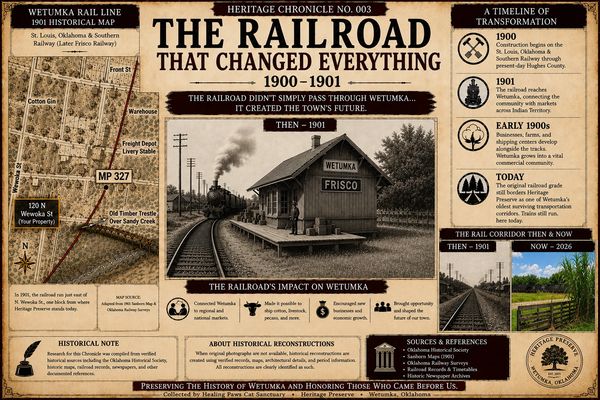
When the St. Louis, Oklahoma & Southern Railway reached Wetumka in 1900–1901, it forever changed the future of this small Creek Nation community. Before the arrival of the railroad, transportation was slow and limited. Farmers, ranchers, and merchants had few efficient ways to move their goods beyond the local area. The new rail line connected Wetumka to communities across Indian Territory and beyond, opening the door to trade, growth, and opportunity.
The railroad quickly became the lifeline of the town. Cotton, corn, pecans, livestock, and other agricultural products could now be shipped to larger markets. Businesses began appearing along the tracks, including cotton gins, warehouses, banks, blacksmith shops, liveries, and freight facilities. Nearly every aspect of Wetumka's early economy revolved around the railroad.
A Corridor That Still Runs Beside Our Sanctuary
One of the most remarkable parts of this story is that the original railroad corridor still borders Healing Paws Cat Sanctuary today.
Our sanctuary sits beside the same historic transportation route established more than 120 years ago. While the surrounding landscape has changed dramatically, the railroad remains an active part of daily life in Wetumka. Trains still travel this corridor, providing a direct connection between the community's past and present.
Every passing train serves as a reminder of the role the railroad played in shaping the town that surrounds us.
More Than Transportation
The railroad did far more than carry freight.
It encouraged new businesses to open, supported local farmers, created jobs, and attracted new residents to the area. Wetumka soon became an important regional shipping center because of its location along the line.
Following the discovery of oil in 1919, the railroad became even more important. Oilfield equipment, petroleum products, and supplies moved through Wetumka by rail, helping fuel another period of economic growth. During this time, additional freight facilities were constructed to handle the increasing volume of shipments.
The Railroad Through Time
Although automobiles and trucks gradually replaced much of the freight business during the mid-twentieth century, the railroad remained an important part of the community's identity.
Today, the line beside our sanctuary continues to serve modern rail traffic, making it one of the oldest continuously used transportation corridors in Hughes County. Few places in Wetumka allow visitors to stand so close to a piece of infrastructure that has remained in service since the town's earliest days.
A Living Piece of History
Unlike many historical landmarks that exist only in photographs, the railroad is still alive.
Visitors to Heritage Preserve can hear the whistle of passing trains, watch modern locomotives travel the same route established in 1900–1901, and imagine what those first steam locomotives must have looked and sounded like as they introduced a new era to Wetumka.
For more than a century, this railroad has connected people, businesses, and communities. It remains one of the defining features of Wetumka's history—and one of the few that continues to operate every day.
Looking Ahead...
The arrival of the railroad gave Wetumka the connection it needed to grow—but what happened next?
In our next Heritage Chronicle, Main Street: The Birth of Downtown Wetumka, we'll step onto the bustling streets of a brand-new town. Discover how businesses, banks, horse-drawn wagons, and merchants transformed Main Street into the commercial heart of Hughes County, using rare photographs from Wetumka's earliest years.
📜 Heritage Chronicle No. 4
Main Street: A Town Is Born
The arrival of the railroad and the official survey of Wetumka laid the foundation for a new community—but it was the people who transformed lines on a map into a thriving town.
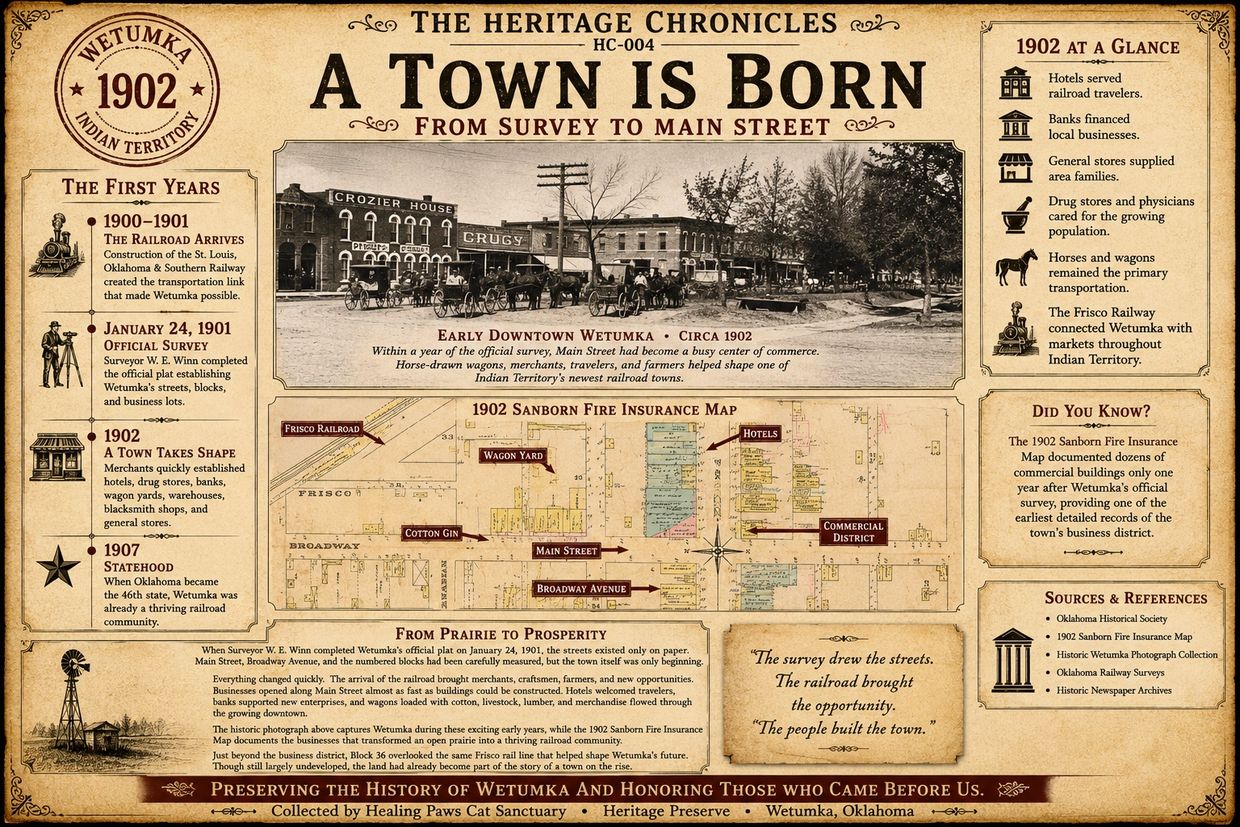
On January 24, 1901, surveyor W. E. Winn completed the official plat of Wetumka, establishing its streets, blocks, alleys, and business lots. At that moment, Main Street and Broadway existed only on paper. Within months, however, those empty streets began filling with businesses, homes, and the sounds of a growing frontier community.
The combination of rail transportation and available commercial property attracted merchants, craftsmen, farmers, ranchers, and entrepreneurs eager to build a new future in Indian Territory.
From Survey Stakes to Storefronts
The growth of Wetumka was remarkably rapid.
Hotels welcomed railroad travelers arriving from neighboring communities. Drug stores, banks, general merchandise stores, blacksmith shops, wagon yards, and professional offices quickly appeared along Main Street. Horse-drawn wagons crowded the streets as farmers hauled cotton, livestock, grain, lumber, and supplies into town for shipment across the region.
The historic downtown photograph featured in this Heritage Chronicle captures Wetumka during these exciting first years. Although automobiles were still rare, the streets bustled with activity as merchants and residents worked together to build one of Hughes County's newest commercial centers.
Mapping a Growing Community
One of the most valuable historical records from Wetumka's earliest years is the 1902 Sanborn Fire Insurance Map.
Originally created for insurance companies to assess fire risks, Sanborn maps documented buildings with remarkable detail, recording construction materials, business names, property uses, and street layouts. Today, they provide historians with an extraordinary snapshot of what communities looked like more than a century ago.
The 1902 map reveals that only one year after the town's official survey, Wetumka already contained a growing business district with hotels, commercial buildings, wagon yards, warehouses, and transportation facilities serving both local residents and the surrounding agricultural community.
Life in a New Railroad Town
During the early 1900s, nearly every aspect of daily life centered around Main Street.
Farmers arrived by wagon to conduct business, purchase supplies, visit the bank, or ship crops by rail. Travelers found lodging at local hotels before continuing their journeys. Merchants stocked their shelves with goods delivered by freight train, while physicians, pharmacists, and skilled tradesmen provided essential services to the growing population.
From sunrise until sunset, Main Street served as the social and economic heart of Wetumka, connecting people from throughout Hughes County.
Block 36: Just Beyond Downtown
While businesses flourished only a few blocks away, Block 36 quietly overlooked the same Frisco rail corridor that made Wetumka's growth possible.
Although the property remained largely undeveloped during these early years, it was already part of the community's story. The railroad that encouraged the town's prosperity still borders Heritage Preserve today, providing a direct connection between Wetumka's earliest days and the sanctuary's mission more than a century later.
Few places in Wetumka offer such a tangible link to the town's founding. Visitors standing along the sanctuary fence can still watch trains travel the same historic route that first brought opportunity, commerce, and new beginnings to this community.
A Town Built Together
Wetumka did not become a successful town because of one building or one business. Its growth was the result of countless individuals working together—surveyors, railroad workers, merchants, farmers, bankers, craftsmen, and families who believed in the promise of a new community.
The streets they built, the businesses they opened, and the relationships they formed helped shape the Wetumka we know today. More than 120 years later, many of those same streets remain, allowing visitors to walk where the town's earliest residents once built their future.
Looking Ahead...
Main Street gave Wetumka a thriving commercial center, but one industry soon came to define the town's economy.
In our next Heritage Chronicle, King Cotton: The Industry That Built Early Wetumka, we'll explore how cotton transformed the local economy, why the railroad made that growth possible, and how the town's cotton gins became the driving force behind decades of prosperity. Using rare historic photographs, including one of Wetumka's early cotton gins, we'll discover how a single crop helped shape the future of Hughes County.
📜 Heritage Chronicle No. 5
King Cotton: The Crop That Built Early Wetumka
When Wetumka was founded in 1901, agriculture quickly became the lifeblood of the community. Among all the crops grown across Hughes County, none proved more important than cotton. For decades, "King Cotton" drove the local economy, supporting farmers, merchants, banks, railroads, and nearly every business in town.
Each autumn, wagons loaded with freshly picked cotton rolled into Wetumka from farms across the surrounding countryside. During harvest season, the streets bustled with activity as families waited their turn at the local cotton gins, where their crop would be prepared for market.
From Farm to Market
Cotton harvesting was hard, labor-intensive work.
Before mechanical harvesters became common, cotton was picked entirely by hand. Entire families—including children during harvest season—often worked from sunrise until sunset gathering cotton from the fields. The freshly picked cotton, known as seed cotton, still contained seeds, leaves, stems, and other plant material, making it unsuitable for sale or manufacturing.
That is where the cotton gin became one of the most important inventions in agricultural history.
The Cotton Gin Revolution
Invented by Eli Whitney in 1794, the cotton gin transformed the cotton industry.
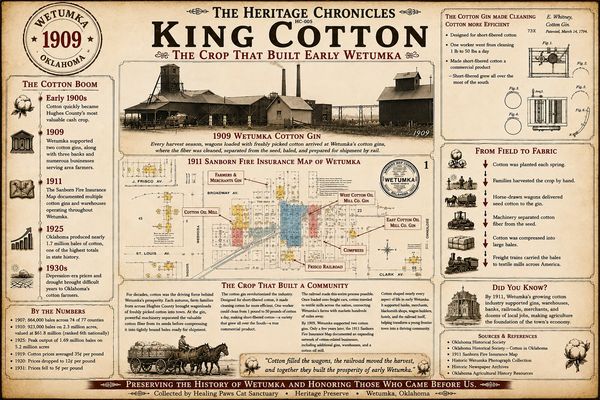
Before its invention, a worker could clean only about one pound of cotton each day by hand. The cotton gin increased that amount to approximately 50 pounds per day, dramatically reducing labor while making cotton production far more profitable.
Designed specifically for short-fibered cotton, the machine separated valuable cotton fibers from the seeds with remarkable speed. Since short-fiber cotton grew well throughout Oklahoma and much of the South, the invention helped turn cotton into one of America's most important commercial crops.
More than a century later, cotton gins like the one photographed in Wetumka continued performing the same essential task—only with larger and more efficient machinery.
Wetumka's Cotton Industry
By 1909, Wetumka had grown into an important agricultural trading center.
The town supported two cotton gins, three banks, warehouses, merchants, hotels, blacksmith shops, and freight facilities, all serving the surrounding farming community. As cotton production increased, the local economy expanded with it.
The 1911 Sanborn Fire Insurance Map provides remarkable evidence of this growth. Rather than showing a single gin, it documents an entire network of cotton-related businesses operating throughout town.
Among them were:
- Farmers & Merchants Gin
- West Cotton Oil Mill Company Gin
- East Cotton Oil Mill Company Gin
- Cotton Oil Mill
- Cotton Compress
- Numerous warehouses connected directly to the Frisco Railroad
Together, these businesses formed the backbone of Wetumka's agricultural economy.
Why So Many Cotton Gins?
As cotton production increased, one gin simply wasn't enough.
Farmers from throughout Hughes County brought their harvests into Wetumka, creating long lines during peak harvest season. Multiple gins allowed cotton to be processed more quickly, reducing delays and helping farmers get their crops to market while prices were favorable.
The presence of several gins also encouraged competition, improved efficiency, and reinforced Wetumka's reputation as one of the region's leading cotton markets.
The Railroad Made It Possible
The cotton industry and the railroad depended on one another.
Once cleaned and compressed into large bales, cotton was loaded onto freight cars waiting along the Frisco Railway. Those trains carried Oklahoma cotton to textile mills throughout the United States, connecting local farms with national and international markets.
Without the railroad, Wetumka's cotton industry could never have reached the scale it achieved.
Likewise, without cotton, the railroad would have carried far less freight through the community.
Together, they transformed Wetumka from a newly surveyed prairie town into one of Hughes County's busiest agricultural centers.
Boom... Then Hard Times
Cotton production continued growing during the early twentieth century.
By 1910, Oklahoma ranked sixth in the nation in cotton production. The state's harvest continued climbing, reaching nearly 1.7 million bales in 1925, one of the highest totals in its history.
Prosperity did not last forever.
Cotton prices fell sharply after World War I and collapsed during the Great Depression. Years of drought, changing markets, and declining production brought difficult times to farming communities across Oklahoma. Mechanization eventually replaced much of the hand labor that had once defined every harvest season, and the number of operating cotton gins gradually declined.
Even so, cotton remained an important part of Wetumka's identity for generations.
A Lasting Legacy
Today, the cotton gins are gone, but their impact can still be seen throughout Wetumka's history.
The businesses they supported helped build banks, schools, churches, homes, and neighborhoods. They provided jobs for generations of local families and helped establish Wetumka as one of the region's important agricultural communities.
The 1909 photograph of the cotton gin and the 1911 Sanborn Fire Insurance Map preserve a remarkable snapshot of that era—a time when cotton truly was king, and nearly every road, wagon, and railroad track led to the harvest.
Looking Ahead...
Cotton helped build Wetumka's economy, but another institution helped safeguard its future—its banks.
In our next Heritage Chronicle, Banking on the Frontier, we'll explore how early financial institutions like the Bank of Commerce and First National Bank financed farms, businesses, and new opportunities, helping transform a young railroad town into a prosperous community.
📜 Heritage Chronicle No. 6
Extra! Extra!
The Newspapers That Told Wetumka's Story
More Than Headlines
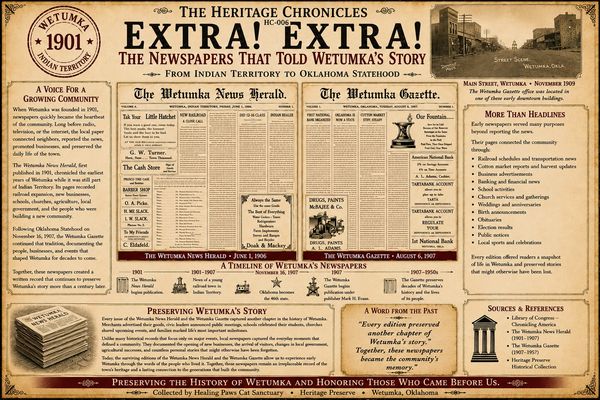
When the first issue of the Wetumka News Herald rolled off the press in 1901, Wetumka was still a brand-new railroad town in Indian Territory. Streets were being surveyed, businesses were opening, and families were building new lives in what would soon become one of Hughes County's growing communities.
For the residents of early Wetumka, the local newspaper was much more than a source of information—it was the town's voice. Every edition connected neighbors, celebrated milestones, promoted local businesses, and documented the events that shaped everyday life. Long before radio, television, or the internet, newspapers brought the community together one story at a time.
The Wetumka News Herald
Published from 1901 through 1907, the Wetumka News Herald recorded the community's earliest years while Oklahoma was still part of Indian Territory.
Its pages reported on railroad expansion, new businesses, local government, schools, churches, farming, and civic improvements. Readers found announcements of weddings and births, reports from community organizations, advertisements from downtown merchants, and notices that kept residents informed about daily life.
Today, those surviving editions provide an invaluable record of Wetumka during its formative years and allow us to experience the excitement of a town just beginning to grow.
A New State... A New Newspaper
On November 16, 1907, Oklahoma officially became the 46th state.
That same year, the Wetumka Gazette began publication under Mark H. Evans, continuing the tradition established by the News Herald. As Wetumka matured, the Gazette chronicled the community through decades of growth, recording everything from new businesses and school activities to elections, celebrations, and the changing fortunes of local agriculture and commerce.
Its pages documented the transition from a frontier railroad town into an established Oklahoma community.
A Window into Everyday Life
One of the most remarkable aspects of early newspapers is how much they reveal about ordinary life.
Advertisements promoted everything from hardware and groceries to clothing, pharmacies, and local services. Readers could find railroad schedules, market reports, social gatherings, church announcements, school programs, and community events—all within the same issue.
The newspapers also reflected the hopes, challenges, and accomplishments of the people who lived in Wetumka. Every edition captured another week in the life of the town, preserving stories that otherwise might have disappeared with time.
Preserving Wetumka's History
Today, surviving copies of the Wetumka News Herald and the Wetumka Gazette are among the most important historical resources available to researchers.
Unlike official government records, newspapers captured the everyday experiences of ordinary people. They recorded the opening of businesses, community celebrations, personal milestones, local tragedies, and countless moments that together formed the history of Wetumka.
The front pages featured in this Heritage Chronicle represent only a small glimpse into those remarkable archives. Each surviving issue continues to preserve the voices of the people who built this community and helps ensure that their stories are never forgotten.
Did You Know?
Many of the businesses advertised in Wetumka's early newspapers were located along Main Street, including the building that housed the Wetumka Gazette office. The 1909 Main Street photograph featured in this Chronicle captures the very streets where readers once purchased their weekly newspaper and gathered to learn the latest news from around town.
Looking Ahead...
Newspapers told the story of Wetumka's people—but another institution helped shape the town's future by financing farms, businesses, and growth.
In our next Heritage Chronicle, HC-007: Banking on the Frontier, we'll explore the early banks that helped transform a young railroad town into a thriving Oklahoma community.
📜 Heritage Chronicle No. 7
Banking on the Frontier
The Banks That Built Early Wetumka
Building Confidence in a New Town
When Wetumka was founded in 1901, it was little more than a newly surveyed railroad community in Indian Territory. Businesses were opening, merchants were stocking their shelves, and families were putting down roots. For a town with big ambitions, success required more than determination—it required financial institutions willing to invest in the future.
Within months of the town's founding, banks became a cornerstone of Wetumka's development. They provided a safe place for savings, extended credit to farmers and merchants, financed new construction, and supported the businesses that helped transform a frontier settlement into a thriving commercial center.
The First National Bank
One of Wetumka's earliest financial institutions was the First National Bank of Wetumka.
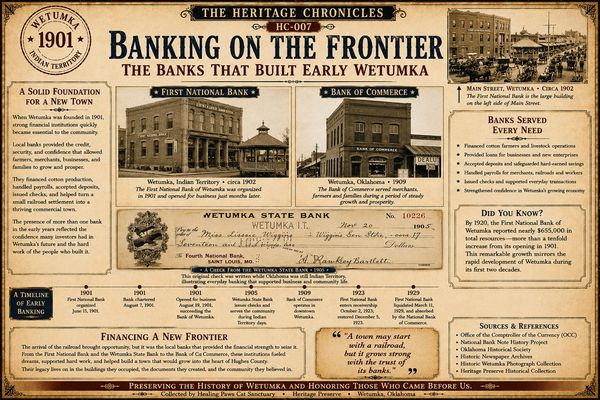
Organized on June 15, 1901, it received its federal charter on August 7, 1901, and officially opened its doors on August 19, 1901, succeeding the earlier Bank of Wetumka. Its arrival came at a pivotal moment, just as Wetumka's streets were filling with new businesses and the railroad was connecting the community to markets across Indian Territory.
As a federally chartered national bank, the First National Bank was authorized to issue its own National Bank Notes, making it an important part of everyday commerce throughout the region. These notes circulated alongside other forms of currency and reflected the growing confidence placed in Wetumka's economy.
More Than One Bank
Wetumka's rapid growth soon supported more than a single banking institution.
The Wetumka State Bank was already conducting business during the town's earliest years, as evidenced by the surviving 1905 check featured in this Heritage Chronicle. Issued while Oklahoma was still Indian Territory, the check offers a fascinating glimpse into everyday financial transactions more than a century ago.
By 1909, the Bank of Commerce had become another prominent fixture on Main Street. Together, these banks served farmers, merchants, businesses, and families throughout Hughes County, providing competition and expanding financial services during one of Wetumka's most prosperous periods.
The presence of multiple banks in such a young community speaks volumes about the optimism surrounding Wetumka's future and the confidence investors had in its continued growth.
Banking a Growing Community
Banks played a vital role in nearly every aspect of life.
Cotton farmers relied on seasonal loans to purchase seed, equipment, and supplies before harvest. Merchants used credit to stock their stores with goods arriving by rail. Families deposited savings, cashed paychecks, and financed new homes. Businesses used checking accounts to pay suppliers and employees, while local governments and organizations depended on banks to manage public funds.
Although banking often happens behind the scenes, it quietly supported nearly every chapter of Wetumka's early history.
Growth That Reflected a Prosperous Town
The success of the First National Bank mirrored the success of Wetumka itself.
When the bank first reported its financial resources in 1901, it held approximately $61,451 in total assets. By 1920, those resources had grown to nearly $654,975—an increase of more than tenfold in less than twenty years.
That remarkable growth reflected the expanding agricultural economy, the success of local merchants, and the increasing importance of Wetumka as a regional center for commerce and transportation.
A Lasting Legacy
Although the First National Bank was eventually absorbed into the National Bank of Commerce in 1929, the legacy of Wetumka's early banks continues to shape the community's story.
The buildings they occupied, the checks they issued, the businesses they financed, and the families they served all became part of the foundation upon which modern Wetumka was built.
The photographs and documents featured in this Chronicle remind us that every growing community depends not only on vision and hard work, but also on the institutions willing to believe in its future.
Did You Know?
The First National Bank of Wetumka was organized only months after the town itself was established in 1901. By 1920, it reported nearly $655,000 in total resources—a remarkable increase that reflected the extraordinary economic growth taking place throughout Wetumka during its first two decades.
The original 1905 Wetumka State Bank check featured in this Chronicle was written while Oklahoma was still Indian Territory, making it a rare surviving artifact from before statehood in 1907.
Looking Ahead...
Banks provided the financial foundation for Wetumka's growth, but they weren't the only businesses shaping the community. Along Main Street, merchants, hotels, pharmacies, hardware stores, restaurants, and countless small businesses created a bustling commercial district that served residents, travelers, and farmers alike.
In HC-008, we'll step inside those storefronts and explore the businesses that made Main Street the heart of early Wetumka.
📜 Heritage Chronicle No. 8
The Heart of Early Wetumka
Building a Community
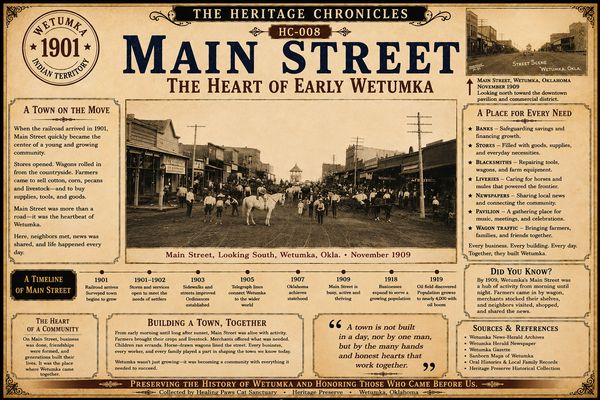
By November 1909, Main Street had become the center of everyday life in Wetumka. Just eight years after the town was officially surveyed and two years after Oklahoma achieved statehood, the once-open prairie had grown into a busy commercial district filled with merchants, farmers, railroad workers, and families.
From sunrise until evening, horse-drawn wagons traveled the unpaved streets bringing cotton, corn, pecans, livestock, and other farm products into town. Merchants opened their doors to customers arriving from across the surrounding countryside, while children walked the wooden sidewalks and neighbors gathered to exchange news. Main Street was where commerce and community came together.
A Town on the Move
The arrival of the St. Louis & San Francisco Railway transformed Wetumka into an important trading center for the region. Businesses quickly lined Main Street to meet the needs of a growing population.
Banks helped finance farms and new businesses. General stores stocked everything from groceries and clothing to hardware and household supplies. Drug stores provided medicines and everyday necessities. Blacksmith shops repaired wagons, horseshoes, and farm equipment, while liveries cared for the horses and mules that powered transportation throughout the community.
Among the early businesses was the Crozier House, believed to have served travelers and residents during Wetumka's formative years. Like many railroad communities, boarding houses and nearby mercantile businesses often stood side by side, providing both lodging and supplies for visitors arriving by train.
The Pavilion at the End of Town
Standing proudly at the end of Main Street was Wetumka's original downtown pavilion. Visible in the historic November 1909 photographs, the pavilion served as a gathering place where residents met for celebrations, community events, political speeches, music, and public activities.
More than a landmark, the pavilion symbolized a town that valued community as much as commerce. It reminded visitors that Main Street was not simply a place to conduct business—it was where neighbors met, friendships formed, and memories were made.
A Moment Preserved in Time
The two historic photographs featured in this Chronicle capture ordinary moments that have become extraordinary through time. They show horses waiting patiently beside wagons, merchants standing in front of their stores, utility poles stretching down the street, and the busy rhythm of a young Oklahoma town.
Every building, every storefront, and every face tells part of Wetumka's story. Together, these photographs preserve one of the clearest surviving views of downtown during its earliest years, allowing future generations to experience the community much as residents did more than a century ago.
Historical Note
The photographs featured in this Chronicle were taken in November 1909 and document Main Street looking both north and south through Wetumka's downtown business district. They provide an invaluable record of the town's architecture, transportation, businesses, and daily life during the early years of Oklahoma statehood.
Did You Know?
By 1909, Wetumka's Main Street included banks, general stores, drug stores, blacksmith shops, liveries, newspapers, and cotton-related businesses, making it one of the busiest commercial centers in Hughes County. Farmers often traveled many miles by wagon to buy supplies, conduct business, and ship their crops by rail.
"Main Street was more than a road—it was the heartbeat of a young community, where commerce, conversation, and neighbors came together to build the future of Wetumka."
Looking Ahead...
As Wetumka's businesses prospered and its population continued to grow, the young community faced new challenges. Streets needed maintenance, ordinances were adopted, public safety became a priority, and elected officials worked to provide the services expected of a modern town. The construction of City Hall marked another important milestone in Wetumka's development, reflecting the community's commitment to organized government and civic progress.
In the next Heritage Chronicle, we'll step inside City Hall and discover how local leaders helped shape the future of Wetumka through government, public services, and the ordinances that guided everyday life.
📚Healing Paws TNR Guide Collection Volume #1📚