WELCOME TO HEALING PAWS CAT SANCTUARY

📜 Heritage Chronicle No. 1
Before There Was a Town... The Beginning of Block 36
Every place has a story.
Some begin with a family.
Others begin with a building.
Ours begins with a surveyor's compass, carefully drawn lines on paper, and a vision for a new town in what was then known as Indian Territory.
Long before Healing Paws Cat Sanctuary called this land home...
before the familiar 1927 farmhouse stood watch over the property...
and before Oklahoma officially became the 46th state...
there was only open land waiting to become something more.
The Survey That Started It All
On January 24, 1901, surveyor W. E. Winn completed the official survey of the future Town of Wetumka. His work laid out the streets, blocks, and lots that would shape the community for generations to come.
Among those carefully measured blocks was Block 36—the very block where Heritage Preserve and Healing Paws Cat Sanctuary now stand.
Although little more than lines on paper at the time, this survey became the foundation for everything that followed.
A Town Takes Shape
The official plat established the streets and lots that transformed open prairie into a planned community.
The St. Louis & San Francisco Railway—better known as the Frisco Railroad—already influenced the design of the town. Along Block 36, the railroad helped define the shape of Lot 7, creating a layout that can still be recognized today.
More than a century later, those same original lots remain part of the landscape we call home.
The Beginning of Our Story
When the survey was completed:
- Oklahoma was still Indian Territory.
- Wetumka had not yet grown into the thriving community it would soon become.
- No farmhouse stood on Block 36.
- No sanctuary existed.
- Only surveyed land and the promise of a new beginning.
Today, Healing Paws Cat Sanctuary is honored to care for this historic property while preserving the stories that came long before us.
The sanctuary is simply the newest caretaker of a place whose history stretches back more than 125 years.
Looking Ahead
The survey marked the beginning of Wetumka's story—but history was already unfolding nearby.
In our next Heritage Chronicle, we'll journey back even further to explore one of the region's earliest educational institutions: The Levering Mission, established in 1880 to serve Native American children in Indian Territory.

📜 Heritage Chronicle No. 2
The Levering Mission... A School Before the State
"Long before there was a Town of Wetumka, there was a school."
When most people think about history, they imagine towns, railroads, or old buildings.
But one of the first landmarks in this area wasn't a business or a railroad depot.
It was a school.
More than two decades before Oklahoma became a state, and years before the streets of Wetumka were surveyed, the Levering Mission opened its doors to Native American children, becoming one of the earliest educational institutions in this part of Indian Territory.
A New Beginning
The Levering Mission was established in 1880 through a partnership between the Creek Nation and the Southern Baptist Convention. Together, they envisioned a place where Native American children could receive both an education and vocational training while living on campus.
The school officially welcomed its first students on September 1, 1881, opening as a coeducational boarding school with fifty boys and fifty girls. Over the next three decades, hundreds of students would pass through its doors, making it one of the region's most significant educational institutions.
More Than One Name
As the years passed, the school reflected the changing history of Indian Territory itself.
It was known by several names throughout its lifetime, including:
- Levering Mission
- Wetumka Boarding School
- Creek National Boarding School
- Wetumka National Boarding School for Boys
Although the names changed, its purpose remained the same—to educate Native American children during a period of tremendous change across the Creek Nation and Indian Territory.
The People Behind the Mission
The story of the Levering Mission is also the story of the people who dedicated their lives to it.
Among them was Alexander Posey, whose leadership and contributions remain an important part of the school's history.
Another was Colonel William Robinson, who served as superintendent during the school's later years. A treasured photograph from 1898 shows Colonel Robinson with his wife and granddaughter, offering a rare glimpse into the people who helped guide the institution through its final decade.
These photographs remind us that history is more than buildings—it is the people whose lives shaped them.
A Lasting Landmark
In 1885, a stone hospital was constructed on the campus to serve the students and staff. Today, it is the only surviving original building from the Levering Mission and stands as one of Hughes County's oldest remaining historic structures.
Recognized for its historical significance, the site was later listed on the National Register of Historic Places, ensuring that this important chapter of Oklahoma's history will continue to be remembered.
The End of an Era
Following Oklahoma statehood in 1907, changes in federal policy gradually brought the school's long history to a close.
After a devastating fire destroyed the boys' dormitory in 1909, the decision was made not to rebuild. The Levering Mission closed its doors in 1910, ending nearly thirty years of service to Native American students.
A Legacy Remembered
Today, only a single stone building remains to tell the story of the Levering Mission.
Yet its legacy extends far beyond its walls.
It reminds us that the history of this region began long before the streets of Wetumka were laid out, long before the railroad arrived, and long before Healing Paws Cat Sanctuary found its home here.
Every Heritage Chronicle is another step in preserving that story.
Looking Ahead...
History was about to move at full speed.
In our next Heritage Chronicle, The Railroad Comes to Wetumka, we'll discover how the arrival of the rails transformed a quiet corner of Indian Territory into a growing community and forever changed the future of Wetumka.
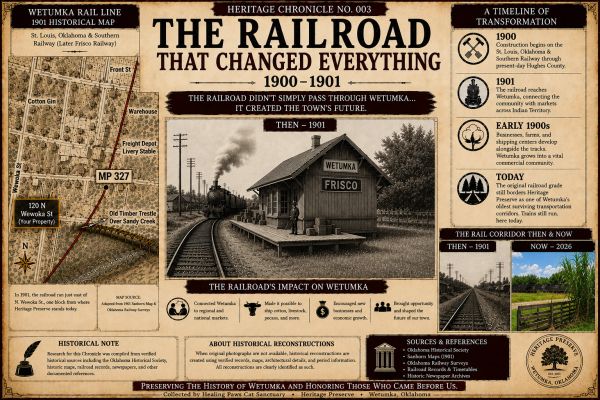
📜 Heritage Chronicle No. 3
The Railroad That Built a Town
When the St. Louis, Oklahoma & Southern Railway reached Wetumka in 1900–1901, it forever changed the future of this small Creek Nation community. Before the arrival of the railroad, transportation was slow and limited. Farmers, ranchers, and merchants had few efficient ways to move their goods beyond the local area. The new rail line connected Wetumka to communities across Indian Territory and beyond, opening the door to trade, growth, and opportunity.
The railroad quickly became the lifeline of the town. Cotton, corn, pecans, livestock, and other agricultural products could now be shipped to larger markets. Businesses began appearing along the tracks, including cotton gins, warehouses, banks, blacksmith shops, liveries, and freight facilities. Nearly every aspect of Wetumka's early economy revolved around the railroad.
A Corridor That Still Runs Beside Our Sanctuary
One of the most remarkable parts of this story is that the original railroad corridor still borders Healing Paws Cat Sanctuary today.
Our sanctuary sits beside the same historic transportation route established more than 120 years ago. While the surrounding landscape has changed dramatically, the railroad remains an active part of daily life in Wetumka. Trains still travel this corridor, providing a direct connection between the community's past and present.
Every passing train serves as a reminder of the role the railroad played in shaping the town that surrounds us.
More Than Transportation
The railroad did far more than carry freight.
It encouraged new businesses to open, supported local farmers, created jobs, and attracted new residents to the area. Wetumka soon became an important regional shipping center because of its location along the line.
Following the discovery of oil in 1919, the railroad became even more important. Oilfield equipment, petroleum products, and supplies moved through Wetumka by rail, helping fuel another period of economic growth. During this time, additional freight facilities were constructed to handle the increasing volume of shipments.
The Railroad Through Time
Although automobiles and trucks gradually replaced much of the freight business during the mid-twentieth century, the railroad remained an important part of the community's identity.
Today, the line beside our sanctuary continues to serve modern rail traffic, making it one of the oldest continuously used transportation corridors in Hughes County. Few places in Wetumka allow visitors to stand so close to a piece of infrastructure that has remained in service since the town's earliest days.
A Living Piece of History
Unlike many historical landmarks that exist only in photographs, the railroad is still alive.
Visitors to Heritage Preserve can hear the whistle of passing trains, watch modern locomotives travel the same route established in 1900–1901, and imagine what those first steam locomotives must have looked and sounded like as they introduced a new era to Wetumka.
For more than a century, this railroad has connected people, businesses, and communities. It remains one of the defining features of Wetumka's history—and one of the few that continues to operate every day.
Looking Ahead...
The arrival of the railroad gave Wetumka the connection it needed to grow—but what happened next?
In our next Heritage Chronicle, Main Street: The Birth of Downtown Wetumka, we'll step onto the bustling streets of a brand-new town. Discover how businesses, banks, horse-drawn wagons, and merchants transformed Main Street into the commercial heart of Hughes County, using rare photographs from Wetumka's earliest years.